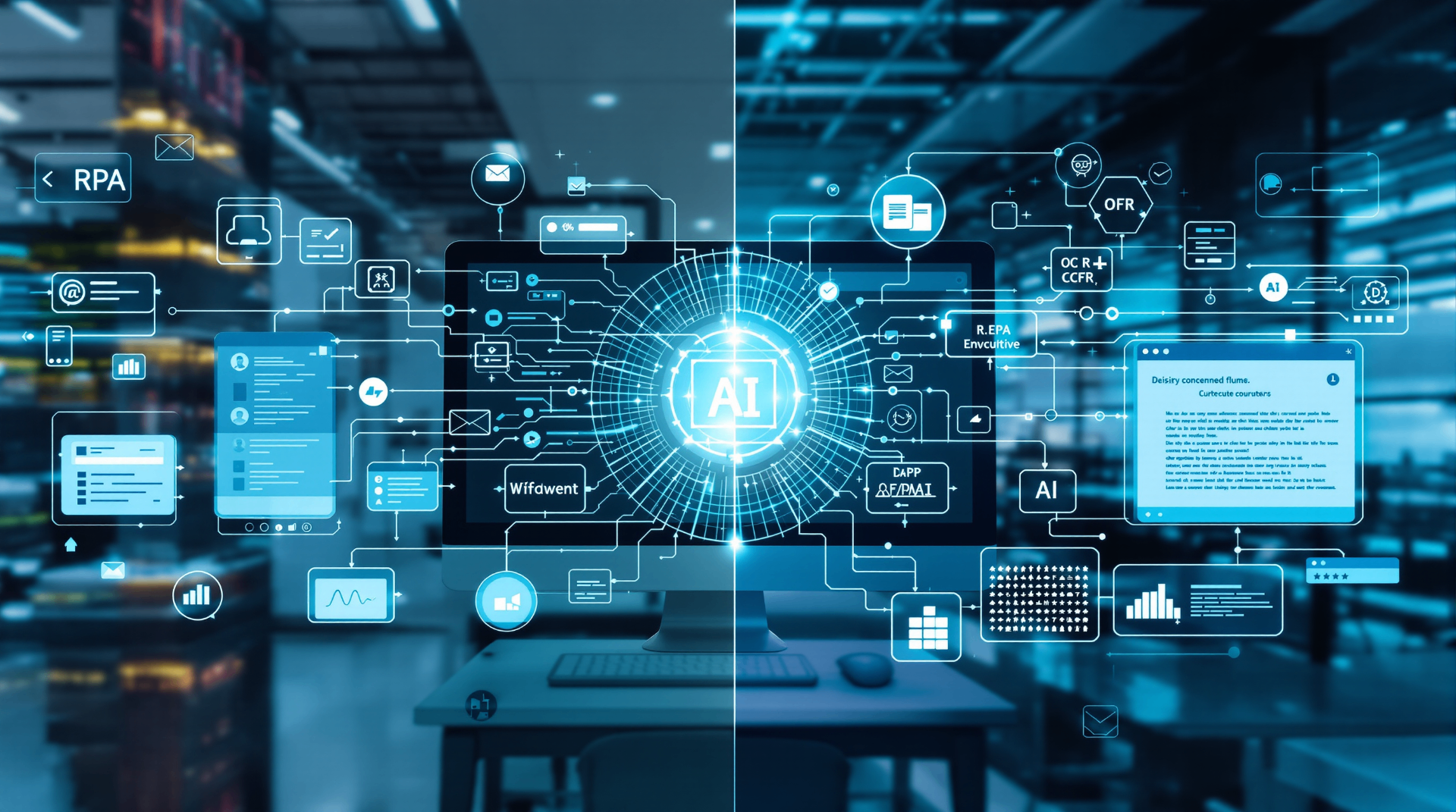
Artificial intelligence and hyperautomation are both reshaping how businesses operate, but they differ fundamentally in scope and purpose. While AI focuses on solving specific intelligent tasks, hyperautomation aims to transform entire processes from end to end. This article explores the key differences between AI and hyperautomation, and explains why understanding this distinction matters for your digital transformation strategy.

Ready to implement AI?
Get a free audit to discover automation opportunities for your business.
Level of automation
AI can automate specific tasks that require intelligence, such as analysing customer sentiment or recommending products. Hyperautomation aims to automate entire processes from start to finish. It not only uses AI for decision making but also coordinates data flows, manages exceptions, and integrates multiple systems and teams.

Goal
The goal of AI on its own is to solve complex problems or mimic human intelligence. The goal of hyperautomation is to transform operations and accelerate digital transformation by automating everything that can be automated. It seeks to create continuous improvements, reduce manual intervention and enable faster, more accurate decision making across the organisation.

Practical implications and benefits
Hyperautomation offers significant advantages. By automating rule‑based tasks with RPA and augmenting them with AI‑driven decision making, organisations can reduce errors, speed up workflows and free employees to focus on creative or strategic work. Process‑mining and analytics tools reveal inefficiencies and help prioritise automation opportunities, while orchestration software ensures that bots, AI models and human workers collaborate seamlessly.

Hyperautomation is already being adopted across industries such as healthcare, finance, supply chain management and customer service. For example, order‑processing workflows can use AI‑based document classification to extract data from invoices, RPA bots to enter information into enterprise systems, and an orchestration layer to route exceptions to human employees.
In supply‑chain operations, hyperautomation can automate inventory checks, procurement approvals and billing. In finance, it can streamline payment processing, compliance checks and fraud detection. These examples illustrate that hyperautomation is not simply "more AI" – it is the coordinated use of multiple technologies to achieve end‑to‑end automation and continuous improvement.