I. Executive Summary
This case study examines the transformational impact of a multi-layered AI virtual assistant on a leading European distributor of professional cosmetics. Faced with high operational costs and scaling challenges in its customer support division, the company deployed an intelligent automation solution that not only solved its core service issues but also became a powerful sales driver. Within six months, the initiative automated 70% of all customer inquiries, reduced the support team from 11 full-time employees to just two supervisors, and drove a remarkable 18.8% increase in overall sales. With a return on investment (ROI) achieved in under six months, this project serves as a compelling blueprint for how e-commerce businesses can convert a traditional cost center into a high-performing revenue engine.
II. The Client & The Challenge: Navigating Growth at a High Cost
The client is a major Polish online retailer specializing in professional-grade cosmetics, managing a vast catalog of over 5,000 products through a B2C marketplace and a dedicated mobile app for beauty professionals. As the business grew, so did the strain on its customer support infrastructure.
The company faced a critical set of operational challenges:
High Volume, Low Complexity: The support team of 11 agents handled approximately 1,000 incoming queries daily. A staggering 70% of these were repetitive, low-level questions such as "Can you recommend a shampoo?" or "Where is my order?".
Intensive Resource Drain: Maintaining a two-shift team for chat and voice support, including two L2 supervisors, represented a significant and continuous operational expense, equivalent to 11 full-time monthly salaries.
Inconsistent Service Levels: While the target response time (SLA) in chat was 90 seconds, this could stretch to five minutes during peak sales periods, leading to customer frustration and abandoned carts.
Ready to implement AI?
Get a free audit to discover automation opportunities for your business.
Missed Revenue Opportunities: The manual support model was reactive. It lacked the capacity for proactive, data-driven cross-selling, upselling, or systematic recovery of abandoned carts.

The business had reached a tipping point where scaling customer support by simply hiring more agents was no longer financially sustainable. A more intelligent, scalable solution was needed.
III. The Solution: A Three-Phase AI Transformation
A sophisticated, multi-layered AI virtual assistant was designed and deployed in three strategic phases, progressively enhancing capabilities from simple query automation to proactive, intelligent selling.
Phase 1: Conversational Chat Assistant
The initial phase focused on tackling the highest volume of repetitive inquiries. A chat-based assistant was deployed on the company's website and mobile app.
Core Technology: The solution was powered by a GPT-4o model, fine-tuned on the specific terminology and application protocols of professional cosmetics. A Retrieval-Augmented Generation (RAG) system allowed the AI to search the product catalog in real-time, while Elastic Search ensured precise filtering and categorization.
Immediate Impact: This phase successfully automated 70% of all incoming chat queries, and the average response time plummeted from 90 seconds to just 10 seconds.

Phase 2: Voice Assistant Integration
To create a seamless omnichannel experience, the AI's capabilities were extended to the voice channel.
Core Technology: Leveraging Speech-to-Text (Whisper), Text-to-Speech (Google TTS), and a LangChain-based dialogue engine, the assistant was integrated with the company's IP-PBX system via SIP.
Impact: The AI began handling 70% of inbound phone calls and was even capable of making automated outbound calls, further reducing the load on human agents and eliminating the need to hire temporary staff during high season.
Phase 3: Intelligent Selling & CRM Integration
This final phase transformed the assistant from a support tool into a proactive sales agent.
Core Technology: Deep API integration with the client's CRM and logistics systems unlocked a wealth of customer data.

Capabilities: - Personalized Recommendations: The AI analyzed order history, browsing behavior, and cart contents to offer intelligent cross-sell and upsell suggestions. - Abandoned Cart Recovery: The system could proactively engage users who had abandoned their carts, offering assistance or reminders. - Real-Time Order Status: The assistant provided instant, accurate updates on order and delivery status by querying the logistics API.
IV. The Results: A Six-Month Impact Analysis
The cumulative impact of the three-phase implementation over six months was profound, delivering quantifiable improvements across every key metric.

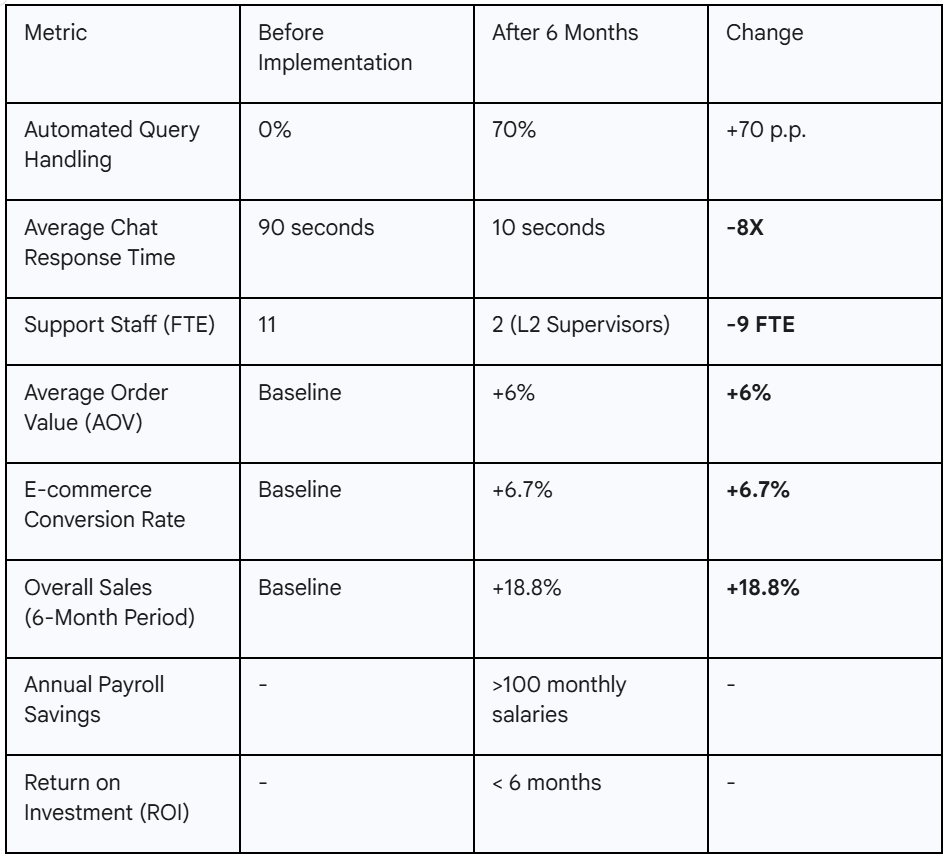
The 18.8% increase in total sales was a direct result of the AI's influence on customer behavior: a 6% lift in AOV from smart recommendations, a 6.7% increase in conversion from instant, expert assistance, and a subsequent 5% growth in order volume driven by higher satisfaction and retention.

V. Conclusion: A New Paradigm for E-Commerce Support
This project demonstrates a pivotal shift in the role of customer service in e-commerce. By leveraging a domain-specific, deeply integrated AI assistant, the client successfully addressed its most pressing operational and financial challenges. More importantly, it transformed its support function from a reactive cost center into a proactive, 24/7 sales and retention machine.
The key takeaways are clear:
Automation Drives Efficiency: Automating high-volume, low-complexity tasks frees up human experts to handle truly complex issues, drastically reducing operational costs.
Speed and Expertise Drive Conversion: Instant, accurate, and expert-level responses build customer confidence and directly translate into higher conversion rates.
Data Integration Drives Sales: Connecting an AI assistant to core business systems like a CRM unlocks the potential for personalized upselling and cross-selling at scale.
By achieving a full return on investment in less than half a year, the company has not only created a more efficient and profitable operation but has also established a scalable foundation for future growth, ready to handle any peak in demand without compromising service quality or financial health.